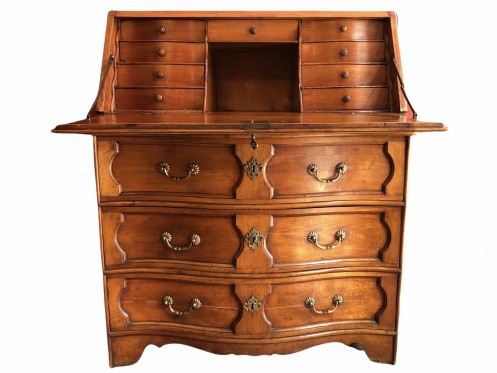
The Regency style gave rise to one of the most imaginative styles in the history of decorative arts, known as rocaille or rococo.
This differs essentially from the Baroque by its lightness and its horror of symmetry. Rococo, with its penchant for whimsy, was widely used by French artisans from 1720 to around 1755-60.
Unbridled imagination is the basis of this new decorative style, in which the dominant motifs are rocks, shells, flowers and foliage. The key words are contrast and asymmetry. From 1730, the movement accelerated and found wider diffusion thanks to the works of ornamentalists such as Gilles-Marie Oppenord and Jules Aurlèle Meissonnier, both authors of drawings with the most extravagant shapes. Among the most fervent cabinetmakers of Rococo, there is necessarily Gaudreaux, one of the leading craftsmen of the time with whom the Crown placed numerous orders. Secondly, when the Louis XV style reached its maturity around the 1750s, Rococo evolved towards a certain softening of forms and above all towards a real simplification of its traditional motifs.
Freed from its first exaggerations and the agitation that characterized it, the style adopts larger curves with a calmer rhythm. Certain artisans working in this pure Louis XV style have produced some of the masterpieces of French furniture. The best known cabinetmaker of this period is probably Jean-François Oeben, whose apprentice is none other than the famous Jean-Henri Riesener, champion of the future Louis XVI style, perhaps the greatest craftsman of all time. Other famous names are Joseph Baumhauer, Lacroix, Jacques Dubois, Saunier, Jean-François Leleu and Bernard Van Riesenburgh. In the 18th century, the joint idea of comfort and intimacy, hitherto unknown, became crucial. The consequences of this change in mentalities are firstly the reduction in the size of living rooms, then the adaptation of furniture to this new space.
The emphasis is no longer on grandeur but on the need to create an environment suited to man, aware of his needs. Thus, thanks to a series of technical advances, combination furniture is increasingly appreciated and used.
These pieces of furniture with multiple functions, which can be transformed into a dressing table, writing table or work table, are among the great successes of 18th century cabinetmaking. As for the seat, the elements that compose it seem to flow into each other, without the slightest interruption of the sinuous line which becomes encompassing. The chair frames are generally decorated with rich sculptures of flowers, foliage and shells. The most characteristic type of Louis XV seat is the bergère, a wide and deep armchair with an enveloping back known as a gondola.
One of them, called a marquise, is simply an enlarged armchair. Others are designed to accommodate three people. The basket-shaped sofa is widely available. The shapes affected by daybeds are also very variable, such as the duchess, which is distinguished by its gondola-shaped backrest. In the field of beds, the columned one from the century of Louis
The medium and small tables also reveal all the refinement obtained by the craftsmen of the golden age of French cabinetmaking. The variety seems to have no limit: pocket tray, jewelry holder, bedside table, work tables, knitters, chiffoniers...
The pieces used for writing are not left out. The simplest and most common models of these tables are the large flat desk and the roll top desk, a mid-century invention, probably due to Oeben. Alongside these desks for male use, cabinetmakers create more feminine furniture, desks of the greatest refinement, decorated with marquetry and bronze, like the happiness of the day. The large and rigid secretary with a flap revealing drawers was introduced around 1750. At the same time, an increasing number of native and exotic woods were flooding the market.
Craftsmen therefore had a very wide range of different veneer woods at their disposal to create complex marquetry, often with floral motifs, but sometimes also in the form of trophies, landscapes and realistic representations of domestic utensils.
The enthusiasm for oriental lacquers also allowed cabinetmakers to adapt them to furniture, by embedding either imported panels or European copies in gilded bronze frames. From the mid-1740s, wood craftsmen stamped their production – or were expected to do so – under the marble of chests of drawers, on the back of the belt of chairs and tables or in a place invisible enough so that the mark did not disturb the aesthetic unity of the furniture. the object.Since the beginning of the Rococo, voices have been raised against asymmetry and the abundant use of sinuous curves. Some in fact believed that this style was unworthy of French nature, always inclined to moderation and restraint.
Finally, following the discovery of Herculaneum and Pompeii, an enormous wave of enthusiasm for antiquity gradually swept away, around the years 1755-60, the Louis XV style in favor of what would become the new neo-classical ideal to which the reign of Louis XVI gave its hour of glory, although upon this king's accession to the throne in 1774, this style had already triumphed for many years.

Louis XV style
-
Categories :
Default
, Styles / Eras