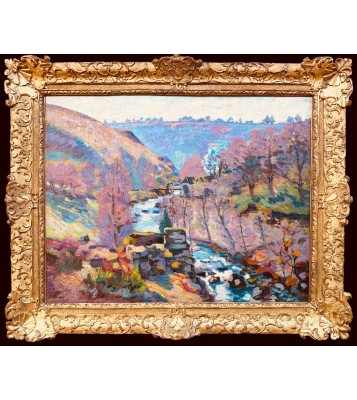
Guillaumin Armand Crozant, Banks Of The Sedelle, Oil On Canvas Circa 1912, Signed, Certificate
GUILLAUMIN Armand (1841–1927)
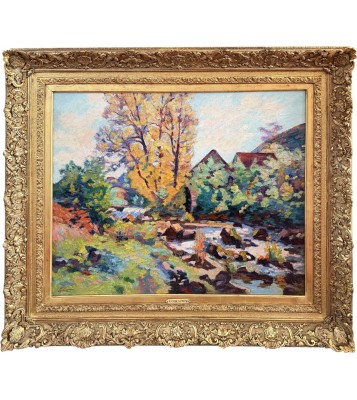
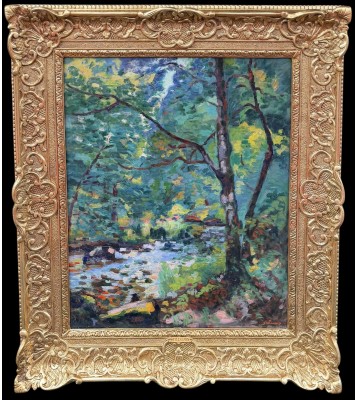
Crozant, banks of the Sedelle.
Oil on canvas, circa 1912, signed lower right.
25,59 x 21,25 in
Certificate of authenticity from the Armand Guillaumin Committee dated December 3, 2025.
This painting will be reproduced in the second volume of the Armand Guillaumin Catalogue Raisonné currently being prepared by the Guillaumin Comite.
Painting listed in Christopher Gray's book on Armand Guillaumin under reference Pl 194, page 202.
Armand Guillaumin was a French painter, lithographer, and draftsman, born on February 16, 1841, in Paris, and died on June 26, 1927, in Orly.
He was one of the first and most loyal members of the Impressionist group. His landscapes of the Creuse, particularly those around Crozant, are among his most prized works.Originally from Moulins, Armand Guillaumin moved to Paris in 1857 to work with his uncle Besnard. He took evening classes with the sculptor Louis Denis Caillouette.
In 1860, he joined the Paris-Orléans Railway Company. The following year, he met Paul Cézanne and Camille Pissarro at the Académie Suisse and participated in the Salon des Refusés in 1863.
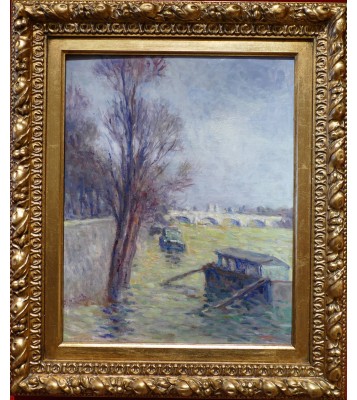
In the early 1870s, he painted in Pontoise with Pissarro. There he developed his taste for landscape painting. He produced his first etching at Dr. Gachet's house in Auvers-sur-Oise in 1872; Guillaumin would produce seventeen throughout his life, as well as a few color lithographs. Joined by Cézanne, they painted on the banks of the Seine around 1873. Armand Guillaumin painted views of the banks of the Seine, particularly of Ivry-sur-Seine, Clamart, and Charenton, as well as landscapes of Épinay-sur-Orge in the southern suburbs of Paris. These views reflect the artist's strong preference for water, a motif that would become one of his favorite subjects. At this time, Guillaumin was already using a fairly bright palette.Armand Guillaumin remained loyal to the Impressionist group. He participated in six of the eight Impressionist exhibitions. In particular, he was present at the first Impressionist exhibition in 1874 and the last in 1886. A friend of Cézanne, he was also close to Van Gogh, who appreciated Guillaumin's talent as a colorist and his vivid color palette.
In 1887, he married Marie-Josephine Gareton, a teacher at the Lycée Fénelon, originally from Creuse. Edgar Degas and Paul Gauguin were his witnesses.
During the 1890s, his painting became more subjective. His highly expressive colors thus anticipated the Fauvists.
In 1891, he won two prizes, one worth 100,000 gold francs and another worth 500,000, in the National Lottery, which allowed him to devote himself entirely to painting. From 1893 onwards, he regularly rented a house in Crozant, where he frequented the painters of the Crozant School, near Fresselines, where the poet Maurice Rollinat lived. Drawing and painting from life, he was always attracted to water. From the banks of the Creuse, he observed the activity on the river, the bridges, and the Chamil.
Armand Guillaumin also made numerous trips to Auvergne and brought back many landscapes, particularly views of Pontgibaud, Saint-Sauves, and Saint-Julien-des-Chazes.
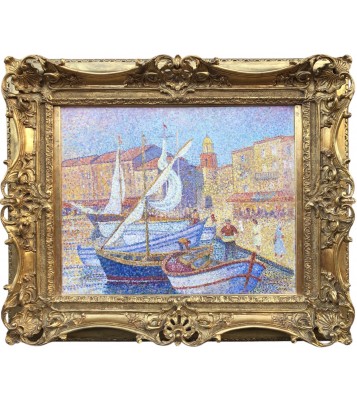
At the beginning of the 20th century, Armand Guillaumin shifted his work towards a tighter style and a brighter, almost violent palette, which, from 1901 onwards, enthused the young Othon Friesz, who declared himself dazzled by the purples, ochres, and violets. He often visited Agay on the French Riviera, where he worked alongside the painter Victor-Ferdinand Bourgeois, producing seascapes and mountain views of the Esterel massif and the snow-capped Alps. Armand Guillaumin then retired to the Creuse region.
He died on June 26, 1927, in Orly, where he was buried in the old cemetery, leaving behind an important body of work featuring paintings from the Impressionist period, followed by Fauvist-inspired works.
Paintings in public collections :
Germany, Cologne, Walraf-Richartz Museum & Corboud Foundation.
In Belgium: Liège Museum of Fine Arts.
In the United States: Baltimore Museum of Art, Columbia, Columbia Museum of Art, New York, Metropolitan Museum of Art, Houston Museum of Fine Arts.
In France:
Bayonne, Bonnat-Helleu Museum, Caen, Carcassonne Museum of Fine Arts, Châteauroux, Bertrand Museum, Clermont-Ferrand, Roger-Quilliot Art Museum, Unterlinden Museum, Dijon, Museum of Fine Arts, Évreux, Évreux Museum, Guéret, Museum of Art and Archaeology, Le Havre, André-Malraux Museum of Modern Art,
Limoges, Limoges Museum of Fine Arts, Palais de L'Evêché.
Paris, Musée d'Orsay, Rennes, Musée des Beaux-Arts, Rouen, Musée des Beaux-Arts, Toulouse Fondation Bemberg, Versailles, Musée Lambinet.
In the Netherlands
Amsterdam, Van Gogh Museum.
In Russia
Saint Petersburg, Hermitage Museum.
In Switzerland, Musée du Petit Palais, Geneva.
GUILLAUMIN Armand (1841–1927)
Crozant, banks of the Sedelle.
Oil on canvas, circa 1912, signed lower right.
25,59 x 21,25 in
Certificate of authenticity from the Armand Guillaumin Committee dated December 3, 2025.
This painting will be reproduced in the second volume of the Armand Guillaumin Catalogue Raisonné currently being prepared by the Guillaumin Comite.
Painting listed in Christopher Gray's book on Armand Guillaumin under reference Pl 194, page 202.
Armand Guillaumin was a French painter, lithographer, and draftsman, born on February 16, 1841, in Paris, and died on June 26, 1927, in Orly.
He was one of the first and most loyal members of the Impressionist group. His landscapes of the Creuse, particularly those around Crozant, are among his most prized works.Originally from Moulins, Armand Guillaumin moved to Paris in 1857 to work with his uncle Besnard. He took evening classes with the sculptor Louis Denis Caillouette.
In 1860, he joined the Paris-Orléans Railway Company. The following year, he met Paul Cézanne and Camille Pissarro at the Académie Suisse and participated in the Salon des Refusés in 1863.
In the early 1870s, he painted in Pontoise with Pissarro. There he developed his taste for landscape painting. He produced his first etching at Dr. Gachet's house in Auvers-sur-Oise in 1872; Guillaumin would produce seventeen throughout his life, as well as a few color lithographs. Joined by Cézanne, they painted on the banks of the Seine around 1873. Armand Guillaumin painted views of the banks of the Seine, particularly of Ivry-sur-Seine, Clamart, and Charenton, as well as landscapes of Épinay-sur-Orge in the southern suburbs of Paris. These views reflect the artist's strong preference for water, a motif that would become one of his favorite subjects. At this time, Guillaumin was already using a fairly bright palette.Armand Guillaumin remained loyal to the Impressionist group. He participated in six of the eight Impressionist exhibitions. In particular, he was present at the first Impressionist exhibition in 1874 and the last in 1886. A friend of Cézanne, he was also close to Van Gogh, who appreciated Guillaumin's talent as a colorist and his vivid color palette.
In 1887, he married Marie-Josephine Gareton, a teacher at the Lycée Fénelon, originally from Creuse. Edgar Degas and Paul Gauguin were his witnesses.
During the 1890s, his painting became more subjective. His highly expressive colors thus anticipated the Fauvists.
In 1891, he won two prizes, one worth 100,000 gold francs and another worth 500,000, in the National Lottery, which allowed him to devote himself entirely to painting. From 1893 onwards, he regularly rented a house in Crozant, where he frequented the painters of the Crozant School, near Fresselines, where the poet Maurice Rollinat lived. Drawing and painting from life, he was always attracted to water. From the banks of the Creuse, he observed the activity on the river, the bridges, and the Chamil.
Armand Guillaumin also made numerous trips to Auvergne and brought back many landscapes, particularly views of Pontgibaud, Saint-Sauves, and Saint-Julien-des-Chazes.
At the beginning of the 20th century, Armand Guillaumin shifted his work towards a tighter style and a brighter, almost violent palette, which, from 1901 onwards, enthused the young Othon Friesz, who declared himself dazzled by the purples, ochres, and violets. He often visited Agay on the French Riviera, where he worked alongside the painter Victor-Ferdinand Bourgeois, producing seascapes and mountain views of the Esterel massif and the snow-capped Alps. Armand Guillaumin then retired to the Creuse region.
He died on June 26, 1927, in Orly, where he was buried in the old cemetery, leaving behind an important body of work featuring paintings from the Impressionist period, followed by Fauvist-inspired works.
Paintings in public collections :
Germany, Cologne, Walraf-Richartz Museum & Corboud Foundation.
In Belgium: Liège Museum of Fine Arts.
In the United States: Baltimore Museum of Art, Columbia, Columbia Museum of Art, New York, Metropolitan Museum of Art, Houston Museum of Fine Arts.
In France:
Bayonne, Bonnat-Helleu Museum, Caen, Carcassonne Museum of Fine Arts, Châteauroux, Bertrand Museum, Clermont-Ferrand, Roger-Quilliot Art Museum, Unterlinden Museum, Dijon, Museum of Fine Arts, Évreux, Évreux Museum, Guéret, Museum of Art and Archaeology, Le Havre, André-Malraux Museum of Modern Art,
Limoges, Limoges Museum of Fine Arts, Palais de L'Evêché.
Paris, Musée d'Orsay, Rennes, Musée des Beaux-Arts, Rouen, Musée des Beaux-Arts, Toulouse Fondation Bemberg, Versailles, Musée Lambinet.
In the Netherlands
Amsterdam, Van Gogh Museum.
In Russia
Saint Petersburg, Hermitage Museum.
In Switzerland, Musée du Petit Palais, Geneva.
Specific References
Biography
-

GUILLAUMIN Armand (1841 / 1927)
Born Jean-Baptiste Armand Guillaumin in Paris, he worked at his uncle's lingerie shop while attending evening drawing lessons. He also worked for a French government railway before studying at the Académie Suisse in 1861. There, he met Paul Cézanne and Camille Pissarro, with whom he maintained lifelong friendships. While he never achieved the stature of these two, his influence on their work was significant. With these two friends, Guillaumin exhibited at the Salon des Refusés in 1863.The three artists frequently painted in each other's company in the 1870s; for a time, Guillaumin and Cézanne had studios next door to each other on the Île Saint-Louis in Paris. In 1873, Cézanne made the only etchings of his career, one of them depicting Guillaumin[1] (see Gallery below).
Guillaumin was a member of the Société anonyme des artistes peintres, sculpteurs et graveurs (later dubbed Impressionistes) from the start and he participated in six of the eight Impressionist exhibitions: 1874, 1877, 1880, 1881, 1882 and 1886.[2] In the eyes of contemporary critics, he became known for his assured brushstroke and use of bold colours. In 1886, an astute critic, Félix Fénéon, called him a "furious colourist";[3] By the 1890s, his palette had grown even bolder, less faithful to nature. He was a Fauve a decade before Fauvism.
Full-time painter
In 1886, he became a friend of Vincent van Gogh, whose brother, Theo, exhibited and sold some of his works. Vincent held Guillaumin's work in high regard, commenting on it in at least 36 letters written from 1888 to 1890.[4] In the mid 1880s, Guillaumin's studio was a meeting place for young artists such as Paul Gauguin, Paul Signac and Georges Seurat. Guillaumin was finally able to quit his government job and concentrate on painting full-time in 1891, when he won 100,000 francs in the state lottery.[2]
Exhibitions and collections
Armand Guillaumin was given large solo exhibitions at many of the top Parisian galleries, including Galeries Durand-Ruel in 1895, Galerie Ambroise Vollard in 1897, Galerie Bernheim-Jeune in 1901 and 1906, and Galerie Paul Rosenberg in 1908. Noted for their intense colours, Guillaumin's paintings are represented in major museums around the world. These include the Musée d’Orsay (48 works) and Petit Palais (91 works) in Paris, the Tate Britain in London, major museums in Germany, Russia, the Netherlands and Spain, the Metropolitan Museum of Art in New York, the National Gallery of Art in Washington DC, the Art Institute of Chicago, and many others in the U.S.A,, Canada, Israel and Japan.[5] Private collectors, many of whom owned dozens of works, bought up his production through the 1920s. Noteworthy among these are Count Armand Doria, Dr. Paul Gachet, Théodore Duret, Gustave Geffroy, Louis Vauxcelles, Tadamasa Hayashi, Sergei Shchukin, Chester Dale and Paul Mellon.
Source Wikipedia : https://en.wikipedia.org/wiki/Armand_Guillaumin