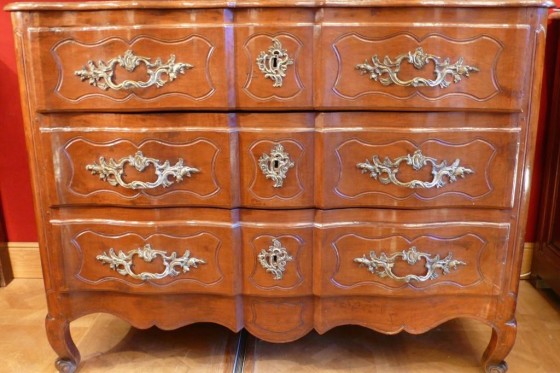
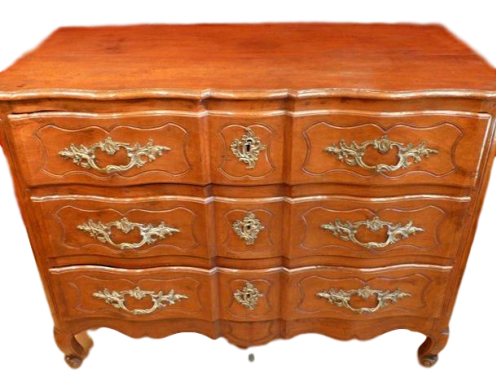
Styles owe a lot to history and/or geography. Conforming to the rule, that of Provençal furniture is influenced by Italian creations, those of Genoa in particular, whose exported furniture is copied and pastiched by Provençal carpenters and cabinetmakers, the fustiers. From the Renaissance onwards, Parisian styles established themselves - with a time lag - in the workshops of artisans in Marseille, Aix, Arles, Beaucaire, Avignon and Forcalquier.
The Provençal spirit was fully expressed in the 18th century with the Regence and Louis XV styles. Let us point out that the rocaille movement owes a lot to the artists of the South, and more particularly to a student of the Marseille sculptor Pierre Puget, Bernard Toro, who published in 1716 a collection of drawings in which the curves and sculptures that we find in Provençal furniture in general and more particularly on large ceremonial consoles triumph. The typically Provençal style was born in Arles, then spread throughout the province.
It is divided into two main trends: the floral style and the so-called Fourques style, the second taking its name from a locality near Arles. Fine and dense sculptures based on plant elements (leaves, flowers and branches) characterize the floral style. the olive branch is often preferred to the acanthus leaf; omnipresent, the famous neighboring rock shell sometimes with ear patterns that recall the meanders of the human ear. Often, elements are openwork such as the lower crossbars of cabinets, consoles or chests of drawers. More sober, the Fourques style is distinguished by hollow sculptures or linear moldings ending in curls rolled into a ram's horn or shell shape: the spiral decoration. From the end of the 18th century, elements of the Louis XVI style - ears of wheat, bunches of fruit, tureen reminiscent of the antique urn, draperies - covered furniture with still Louis XV structures and shapes. The two styles coexisted throughout the 19th century.
Another characteristic of Provençal furniture, bobèches (Arlesian name), plumets or mouchets (names given in Avignon), small sculptures or turned pieces in the shape of a plume, crowned by an acorn or an olive, which crown the top and the corners of the panetières and the upper part of the seat uprights. If inlaid and painted furniture is relatively rare, if we except the cabinets from Uzès which can be arbitrarily linked to the Provençal style, on the other hand there is no shortage of pieces in natural wood. From the 18th and 19th centuries, and more rarely from the 17th century, they enjoy keen interest from enthusiasts who appreciate the density and quality of the sculptures.