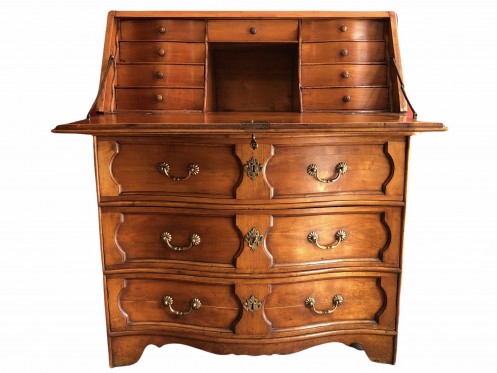
The chest of drawers appeared at the end of the 17th century. It bore its current name from 1708 and became the most widely manufactured piece of furniture. The Pitti Palace, in Florence, contains a chest of drawers dating from 1550. In Savoy, there are Louis XIII chests of drawers. Provence invented the crossbow chest of drawers, that is to say with a double projection front. Dauphiné has chests of drawers with “pleated” fronts, with several projections.
Officially, this piece of furniture was born in Paris in 1695. The first chests of drawers recall their origin: the cabinet, a successful piece of furniture in the 12th century, a box with numerous small drawers behind two doors, and placed on a high base. The chest of drawers is a box placed almost on the ground, on short legs, offering three large drawers. Its name comes from the fact that it proved so practical that it enjoyed rapid and significant success. Non-existent in rural areas, it invades various French towns. Of all the regional chests of drawers, the best known is that of Bordeaux, characterized by its pot-bellied appearance. The first chests of drawers are rather cubic (or exactly orthohedral, rectangular parallelepipeds) with straight uprights and sides, a silhouette which corresponds well to the taste of Lyon, where the first type of Lyonnaise chest of drawers appears in this appearance, the most characteristic. Rectangular in plan, it has a slightly curved facade. Like the cabinets, it has larger dimensions than the Parisian chests of drawers (1.28 m): 1.33 m wide by 0.63 cm deep. It is entirely made of walnut, including the top, which is never marble or “stone”.
It already has a decor specific to all Lyon chests of drawers: moldings divide the front of the drawers into three, like the cabinet doors, with a smaller central panel. A sculpted motif adorns each end and quite often frames the keyhole. The Lyon chest of drawers also knows the crossbow front and even the pleated front. Finally, more rarely, it goes beyond its limits and its rectangular plan to offer itself a rounded plan, also called scalloped, with a façade and a potbelly profile, less so than the Bordeaux. According to some acceptance, it is called a tomb, although other specialists use this name for any chest of drawers with three or four drawers and short legs. A very Lyonnais base consists of fairly strongly arched legs, marked by a protruding edge.
There is nothing rustic about Lyonnais furniture. It influenced the furniture of the surrounding countryside but it was only aimed at rich bourgeois people, bankers, silk workers, large merchants, the nobility in this large city practically not existing under the Ancien Régime. The Lyonnais furniture is part of a structure perfectly located on the ground. The sculpted ornamentation is inspired by models imported from the capital. The scrolls, a contemporary expression of arabesques, are influenced by the creations of Jean Bérain (1639/1711), designer of the king's bedroom, whose decorations mark the transition between Louis XIV and the Regency. The newer shells followed closely, soon accompanied by the lace sculpture developed by Parisian ornamentalists. But the laurel branches, so frequent, are typically Lyonnais; and they were already suggested in Renaissance sideboards.